This week in eLearning and Digital Cultures was all about being
human. In addition to watching videos and reading articles, there was an
Image Contest. We were invited to create an image that illustrates a
theme in the course and upload it to Flickr with the tag, #edcmooc. Using
Flickriver’s “interestingness” rating (based on comments, favorites, and
clickthroughs), the instructors will identify the top five images, and
the winners will receive a Gelaskin cover for their phones, customized to depict their winning image.
Instead of providing a narrative about my experience this week, I am going to share my image, which I’ve titled “Perspective”:
You help my interestingness rating by viewing, commenting on, or favoriting my image on Flickr and you can view the other student’s images.
Sunday, February 17, 2013
Wednesday, February 13, 2013
Angry Birds: A model for learning
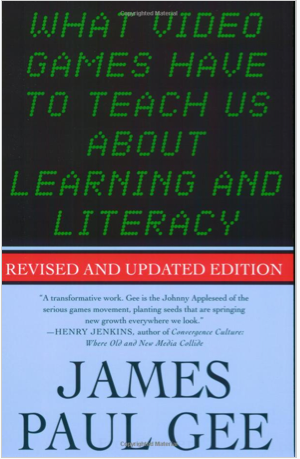
Renown literacy scholar James Paul Gee is the author of What Video Games have to teach us about Learning and Literacy, which outlines 36 principles for good learning.
Gee derives the principles from what he’s observed as a gamer and from
interviews with gamers, and he argues that the same things that make a video
game good could (and should) be applied to school learning. Gee specifically
focuses on immersive role-playing and first-person-shooter games, but many of his
learning principles about basic skills, practice, and rewards apply to much
simpler games, including Angry Birds.
Basic Skills
Two of Gee’s principles about basic skill acquisition are
prominent in Angry Birds: the
“Bottom-Up Basic Skills Principle” and the “Discovery Principle.” The bottom-up
basic skills principle states that skills are not learned in isolation;
instead, the learner discovers the skill as she engages in the activity. As Gee
puts it, “by the time new players are aware of what are basic skills in a given
type of game … they have already mastered them” (140). That said, throwing
learners into an unknown environment without any overt instruction is not
advisable. As Gee explains, humans “need immersion in actual contexts of
practice, but they can find such contexts confusing without overt information
and guidance” (114). This is where the discovery principle comes in—overt
instruction exists, but is kept to a minimum, allowing the learner to
experiment and explore.
In Angry Birds, the
overt instruction happens every time we are introduced to a new bird:
Notice the subtlety of this “instruction”—there are no
words, the image doesn’t fully demonstrate the bird’s capabilities, and once
you press the check, you don’t get the image again. You learn the rest through
actually playing the game. As you experiment, you find out that the red bird is
good at breaking wood, but not anything with metal around it, and the blue
birds are especially adept at breaking through ice. The “training” for the
yellow bird makes it look like the bird will change directions when you tap
your finger, but it actually speeds up in the direction that it was already
heading and thus very good for breaking through dense structures.
Situated Practice
As you continue playing the game, you learn more about the
different birds’ abilities, and you are introduced to more birds. You are also
forced to adopt more sophisticated strategies, which is all facilitated through
practice. Angry Birds’ approach to
practice is particularly indicative of Gee’s “Practice” and “Regime of
Competence” principles. The key to the practice principle is that engaging in a
task over and over is not boring because the learner experiences ongoing
success; she needs to feel like she is moving forward and not simply repeating
the same skill. Part of what makes practice enjoyable is illustrated by the
regime of competence principle, which states that the learner is operating on
the outer edge of her abilities such that the task is challenging, but not
impossible. (Gee 65-68)
Practice is built into every aspect of Angry Birds. The first levels only involve the red bird, and often
multiple red birds, so the player repeatedly practices positioning the
slingshot so that the bird hits the structure at the desired angle. Furthermore,
players are encouraged to play the levels multiple times either because they
were not successful on the first attempt or because they only earned one or two
out of the three possible stars. This repetitive practice is further reinforced
because most levels take less than a minute to play, so it is not a big
commitment for the player to repeat a level and experiment with different
strategies. This repetition does not seem dull because success is constant;
players are rewarded with points any time their birds hit a structure or a pig,
they are rewarded by the three-star system, and they are rewarded by the
potential for earning new high scores when they repeat levels.
The regime of competence is similarly ingrained in Angry Birds, and is especially
noticeable from level to level. For example, I learned from the first few levels
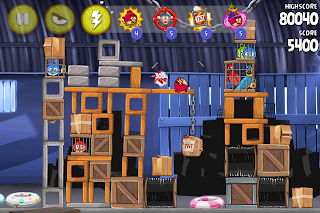
of Angry Birds Rio that aiming my
bird at the base of a structure was sure to knock it down and it meant I earned
more points because I received points for breaking up the structure as well as for
releasing the birds from their cages.
However, when I tried the same strategy a few levels later,
it didn’t work, partly because the base was made of metal, which the red bird can’t
break through.
After several unsuccessful attempts, I finally tried
shooting the red bird high over the structure, and found that, in this
instance, a dive-bomb was better than attacking the base.
Charles Mauro, president of Mauro New Media, argues that practice in Angry Birds is particularly
enjoyable because the designers cleverly managed response time. Instead of making
the flight of the birds fast, players watch a slow progression along a clearly
marked trajectory, which gives the player time to think about error correction.
In my case, it meant I attempted to shoot the red bird at the base in a variety
of ways because I hoped a different angle would produce better results. There
is also a time delay between when your last bird hits the structure and when
the screen comes up to allow you to retry the level or continue to the next
one. Mauro argues that this delay gives the player “time to structure an error
correction strategy.” In my case, it meant I considered the structure more
closely, ultimately deciding that I needed my bird to dive-bomb into the middle
of things.
It didn’t take much for me to try a new strategy and I was
certainly capable of finding a solution, but it took longer to pass this level
than any of the others in that first episode. Success was well within my regime
of competence, but the game was forcing me to experiment until I was willing to
shift my previous assumption that there was one “best” way to bring down a
structure.
Rewards
Rewards are a crucial part of motivating players to practice
skills within a game and to continue playing the game when they are brought to
the edge of their regime of competence. Games also cater to players with
various skill sets, which is precisely what Gee’s “Achievement Principle” is
about: from the beginning, there must be intrinsic rewards for all learners, and
the rewards should be customized to each learner’s level, effort, and growing
mastery (64).
Angry Birds most
prominently accomplishes this through points and through the three-star system.
The points are important because even if you don’t hit the pigs (or cages in Rio), you can still earn an incredible
amount of points by hitting the structures and making things explode, which
makes the levels satisfying even if you don’t win.
When you do win, you pass the level with one, two, or three stars,
thus allowing players of various skills to play through the entire game. Interestingly,
the points and stars are separate reward systems—as you’ll notice below, I
earned almost the same amount of points for a one-star win as I did for a
three-star win on another level.
So what makes players go for three stars? In the case of Angry Birds Rio, the answer is bonus
levels. After I completed the first 15 levels, I had earned 26 stars; bonus
levels were available for 30, 50, and 70 stars.
Immediately, I replayed a couple of levels and earned four
more stars. A better player might have been closer to the 50- or 70-star
levels, and probably would have felt the same nudge to go ahead and get those
few remaining stars required to claim the reward. I should also note that I
didn’t feel bad for being at the lowest level—I was pleased to be able to
unlock a bonus at all.
For the players who easily collect stars for level
completion, Angry Birds offers additional
challenges—players can hunt through the levels and collect special rewards that
are tracked in the Awards Room.
Closing Thoughts
Angry Birds is a
lot of fun to play, and Gee’s principles show that what makes it fun is that it
both requires learning and rewards learners at various skill levels. I find this
interesting in part because I don’t think many people would call what they do
when they play Angry Birds learning. But
what’s even more interesting is that I could have done this analysis on any game. These principles aren’t
specific to Angry Birds or to
first-person-shooters or to video games; they are generalizations about the way
humans learn, generalizations that prove that learning even the most menial task
can be quite fun if it’s framed with ample rewards and an appropriate balance
of instruction and discovery that pushes learners to the edge of their individual
competence levels.
Unfortunately, Gee argues, in school, “many so-called
advantaged learners rarely get to operate at the edge of their regime of
competence … [and] less advantaged learners are repeatedly asked to operate outside
their regime of competence” (68). The solution is not to create an Angry Birds-type game that teaches math
or grammar. The solution is to apply Gee’s principles to school learning; one
way to start is to create a reward system that acknowledges and incentivizes learners
at various skill levels.
Sunday, February 10, 2013
My MOOC Experience (#edcmooc) – Week Two
This week in eLearning and Digital Cultures was rather meta.
We read two opinion pieces about MOOCs, Napster,Udacity, and the Academy and QuestioningClay Shirky, and watched a lecture about open education byGardner Campbell.
In “Napster, Udacity, and the Academy,” Clay Shirky compares
higher education with the music industry. He argues that Napster and MP3s told
the world that you don’t have to buy a whole CD; you can just buy one song. He
claims that MOOCs are similarly offering a new narrative: education doesn’t
have to be something that only the elite can access, and maybe we don’t need to
buy a whole degree; maybe we should just download the courses we need. Shirky points
to the inhibiting expense of a college education to bolster his argument: “an
undergraduate education used to be an option, one way to get into the middle
class. Now it’s a hostage situation, required to avoid falling out of it.”
Aaron Bady responds to “Napster, Udacity, and the Academy” in
“Questioning Clay Shirky.” He criticizes Shirky’s lack of evidence that online
education is valuable or that MOOCs are truly “open,” and argues that a
comparison of higher education and the music industry is problematic. He
further contends that Shirky is dividing students into “elite” and “non-elite”
and then not expecting MOOCs to offer the same quality of education as
institutions like Harvard, but Bady’s arguments get a little confusing because
it seems that he’s advocating for quality online education while at the same
time condemning MOOCs for being the equivalent of “a link to WebMD as a
replacement for seeing a real doctor.”
I wasn’t particularly impressed with either of the articles,
mainly because both authors are so defensive of their positions that their
arguments lack balance. Instead of pitting MOOC supporters against the academy,
I’d like to see the conversation back up to more fundamental questions: What is
the purpose of higher education? What intrinsic value do students gain from a
four-year degree? Is there something in the four-year experience that’s inherently
valuable, or is the value tied to the specific institution?
In his keynotelecture at Open Ed in October 2012, Campbell approaches these questions,
claiming that there is a tension between what education is supposed to do (he draws on Bateson’sHierarchy of Learning to argue that education should push students to think
differently and creatively), and the structures built into institutions of
higher education that force students to “play the game” of learning to satisfy
the teacher’s expectations and earn an A.
I think Campbell would say we need to not only ask, what is
the purpose of education? But also, how can we change our education practices
and structures to actually accomplish that purpose? With this framing, I don’t
think it needs to be Higher Education versus The MOOCs. Instead, MOOCs, for-profits,
non-profits, ivy leagues, community colleges, state schools are all part of a larger
conversation that is trying to solve a very real problem.
PS: Students from the University of Edinburgh joined the
MOOC this week; they created digital artifacts and posted them on the course
site. Here is my favorite, by Amy Woodgate:
Sunday, February 3, 2013
My MOOC Experience (#edcmooc) – Week One
It’s been an interesting week! The topic was utopian versus
dystopian views of technology—we explored this by watching four videos, reading
a couple of articles about technological determinism, and exchanging ideas via
the discussion forums, blogs, and twitter. The five instructors also hosted an
hour-long Google Hangout on Friday.
While I found the videos and articles interesting, I find
myself more intrigued by the structure of the MOOC. I expected a self-motivated
environment, but I was surprised at just how much the learning depends on my
willingness to participate. There is an implied expectation that we watch the
videos and read the “core” article (there are also quite a few “advanced”
articles in the Week One Resources), and there is a clear directive that we are
to engage in two of the various conversations happening in the forums and on
social networks. But no one is checking to make sure we do this.
I found the structure strange at first, but ultimately
empowering. I began by watching each of the four films and making notes. Then I
started reading the core article. And I just wasn’t into it. So I stopped
reading. I skimmed a few of the advanced readings, watched another video, browsed
the discussion forums. I was surprised at how much I enjoyed this nonlinear
survey of the materials, and I soon found myself connecting the ideas to my own
preoccupations (in this case, what readings to assign my first-year composition
students next quarter).
I did not choose to post in the forums, but I was impressed
with how many of the responses were expanding upon what others had said, and
with how many students were starting their own threads to take the discussion
in new directions. I can’t help but assume that this positive engagement is the
result of thousands of people having the flexibility to choose how to engage—it
seems to foster an environment where we only contribute if we actually have
something to say. For me, being a passive observer was sufficient because it
led me to a very active (though private) application of the ideas.
Clearly, I will get out of this MOOC what I put into it. No
one is monitoring me or grading me, and that’s not why I’m taking the course. Without
the grades and expectations, I’m free to engage with the material and use it in
a way that actually applies to my life. On the other hand, I feel like my
approach makes this MOOC a supplement to
work I’m already doing; I don’t know how much I would be getting out of it if I
wasn’t already interested in elearning and digital cultures. But, of course, I
wouldn’t have volunteered to take the course if I wasn’t interested.
Before signing off, I want to make a quick comment about the
Google Hangout (which I've embedded below), partly because it was fascinating enough for me to sit through
the full hour of recorded video. The five instructors addressed common
questions they had seen arise from the community throughout the week, and gave
their reactions to and reflections upon the community’s discussions, often
drawing from specific blogs or forum posts. It felt like a panel at a
conference, and I walked away feeling confident that the people who developed
this MOOC are truly experts on the topic of elearning and digital cultures. Listening
to them made me feel like I was part of something. It was exciting. The only
thing I would change is to have had that Hangout on Day 1.
Wednesday, January 30, 2013
Typing to Learn: A Technobiography
My mother is a something of a Jill-of-all-trades. She teaches
piano lessons, does occasional work for a friend in real estate, and runs the
books for an automotive shop. She also rides a Harley and plays in two rock
bands, but that’s another story. She trained as an accountant in college, and
for as long as I can remember she has done freelance CPA work, which means she’s
had an office in the house. When I was little, the office was equipped with a
desktop computer and one of those printers that printed on that fabulous
green-white-green-white lined paper. I used to sit on the floor and peel off the
perforated edges.
As often as I could possibly manage, I would retrieve a
hot-pink floppy disk from the filing cabinet and climb into Mama’s deep purple,
faux-leather office chair. Concentration. I loved
that game. It was memory and wheel-of-fortune all at once – you had to
remember what pictures were on the other sides of the cards you’d already
selected and when you found a match they disappeared, revealing a series of
images that represented syllables and inevitably included an awl. The goal was to
guess the phrase before you made all the cards disappear.
There were disks with other games, too. Bubba enjoyed Oregon
Trail, and I guess I did at first, but I always wound up dead from dysentery
and I came to take it as a personal offense. Mama also bought us a learning
game called Treehouse – I remember her being so pleased to have presented her
children with such a technologically advanced educational activity. I enjoyed the
speed typing games and vocabulary builders, but I was inevitably drawn back to
that hot-pink floppy.
Of course Mama’s desktop wasn’t the only
technology in my childhood. We had two televisions, one in the living room and
one in Mama and Daddy’s bedroom. When one of those got turned on, it was an event. Every Tuesday night, Daddy and Bubba would watch “SeaQuest” while
Mama and I watched “Murder, She Wrote.” On Sunday nights we watched whatever
made-for-TV movie was on the basic network (we never had cable). Commercials
were spent running around to get a snack or go to the restroom, and someone
would holler “SHOW” real loud when it came back on and we’d scurry to our
seats. Not having cable never seemed to be an issue at the time, but as I got
older I realized that I missed out on some cultural references that are still a
big part of my friends’ lives today.
We moved to a suburb when I was in fourth grade (1994), and
that’s the first time I remember technology in school. We had typing class once
a week in the computer lab, and I took a lot of pride in getting high-speed
scores. Beyond that, though, I don’t recall using computers as part of my elementary
education.
What I remember using that computer for was chatting with friends on AOL. I would sit for hours and chat—I was right at the age when girls stereotypically become big phone-talkers, but synchronous chat completely replaced the telephone. For whatever reason, I never ventured into other online communities like chat rooms, though I knew they existed.
As I got older, technology became an increasingly central
part of my life. My parents bought me a
cell phone when I was 16, and I have had one ever since (I have never owned
landline). I continue my parents’ tradition of avoiding cable, but I have
always owned a TV and I frequently watch shows through Hulu and Netflix. Facebook
made its entrée into society my freshman year of college, and it quickly
replaced AIM as my way of communicating with friends. I have moved around a lot
since then, and Facebook has become a crucial part of maintaining distance
relationships.
The ways in which I use technology for entertainment and
communication feel completely natural, but even more natural is the way I use
computers as tools for writing. My
early enthusiasm with typing class and speed-typing games seems to have established
a connection between writing and the computer that is irreversible. I rarely
write by hand, and in fact feel uncomfortable doing so for anything longer than
a grocery list. But something even stranger has happened—I feel as though I think best when I am typing. I nearly
transcribe interesting meetings or classes, and I always “type through” ideas
in a freewrite style. It is as though my learning style is tied to typing—instead
of being a visual or auditory learner, I am a textual one, but not in the sense
that I need to read to learn. I need to produce
words to learn. And whether it is a symbol that represents a word or letters
pressed by my fingers, to me, words exist on the screen.
Subscribe to:
Posts (Atom)